
Matching Service Registries
Overview
Across the United States, more than 1.5 million individuals and families self-direct their own home care services through Medicaid or other publicly funded programs. The self-direction model (also known as consumer direction) promotes choice, control, and flexibility, supporting individuals’ overwhelming preference to age and receive services in their homes and communities. Yet, in the context of widespread workforce shortages, many consumers and families struggle to find and retain independent providers (i.e., home care and/or respite care workers)—while independent providers often struggle to find clients and attain sufficient hours and stable schedules.
Matching service registries are one promising solution. Matching service registries are online resources that connect independent providers with consumers and family caregivers. Most registries enable independent providers to create profiles that are searchable on the basis of geography, skills, experience, availability, and other factors, and some registries also allow consumers/family caregivers to post specific jobs. Some matching service registries cover a range of home care service types, while some are specific to respite care. While primarily supporting publicly funded self-direction and/or respite care programs, some registries are available for use by home or respite care agencies and/or by private-pay consumers.
PHI maintains this national inventory of public and nonprofit matching service registries to showcase the range of registries in operation and to inspire and inform state and local efforts to create new registries or improve existing ones. This list of registries is not exhaustive, and we welcome new or updated information at any time; see contact information below.
For deeper guidance on designing and strengthening these registries, see PHI’s report Matching Up: Seven Considerations for Impactful Matching Service and Respite Registries. Drawing on real-world examples from registries nationwide, it offers practical steps to help policymakers, nonprofits, and other stakeholders build registries that expand access to care while supporting stable, quality jobs for direct care workers.
This matching service registries resource complements the list of respite-specific registries maintained by the ARCH National Respite Network and Resource Center.
KEY FINDINGS
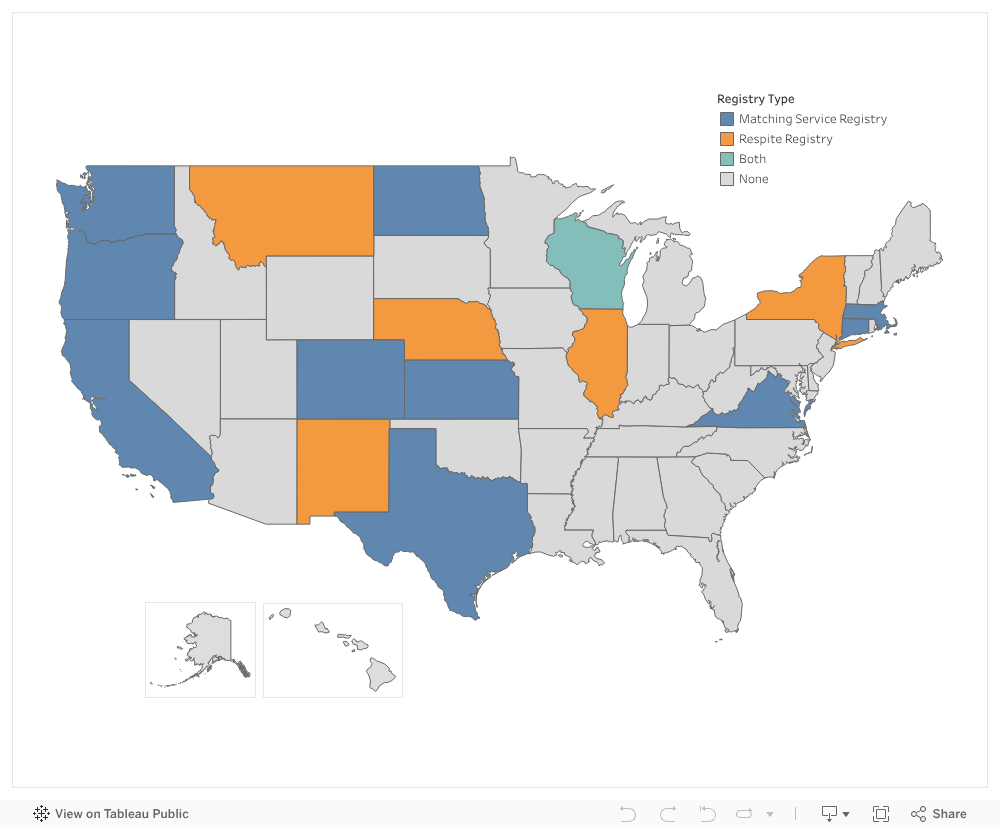
PHI has documented 12 registries in operation across 16 states, including:
- Six matching service registries in 11 states (California, Colorado, Connecticut, Kansas, Massachusetts, North Dakota, Oregon, Texas, Virginia, Washington State, Wisconsin).
- Five of these registries offer a respite care option.
- Four matching service registries operate across multiple states (Carina, Direct Care Careers, QuickMatch, RewardingWork).
- Six respite-specific registries in six states (Illinois, Montana, Nebraska, New Mexico, New York, Wisconsin)
- Two of these respite care registries operate within Aging and Disability Resource Centers (Montana and Nebraska).
- 11 registries are statewide; one operates regionally.
- Six registries enable both independent providers and consumers to create searchable posts; others allow independent providers to make profiles that consumers can search.
- Four registries allow home or respite care agency employers to use the registry to recruit staff.
- Six registries require users to register and create a profile before being able to search the registry, five are open access, and one varies by state.
- Three registries require a background check.
- Eight registries require users to communicate with each other outside the registry; the others allow for internal, or both internal and external, communication.
Please contact Jessica King at jking@PHInational.org with information about new or existing registries in your state or locality.
The 2025 update to PHI’s matching service registries inventory was supported by the Administration for Community Living (ACL), U.S. Department of Health and Human Services (HHS) as part of a financial assistance award totaling $1,250,000 with 75 percentage funded by ACL/HHS and $416,667 and 25 percentage funded by non-government source(s). The contents are those of the author(s) and do not necessarily represent the official views of, nor an endorsement, by ACL/HHS, or the U.S. Government.
Key Terms
Consumers: Individuals who seek and receive home care services; may receive ongoing services or respite care only.
Self-directing consumers recruit and manage their own workers rather than receiving support through a home care agency).
Family Caregivers: Family members who provide and/or manage care for a family member; care may be paid or unpaid.
Agency Provider: Any agency or organization that offers home and/or respite care services; may also provide other services.
(Note: The term “agency employer” is used here to specify when agency providers can use a registry to recruit independent providers.)
Independent Providers: Direct care workers who are employed directly by individuals or households; may be paid through Medicaid self-direction programs, private funds, or other payment streams.
LIST OF REGISTRIES
Matching service registries are listed in alphabetical order; respite-only registries are listed separately at the end.
Name of Registry: Carina
Type: Matching service registry platform with a respite option
State(s): Oregon, Washington State
Region Covered by Registry: Statewide
Registry Users:
- Independent providers
- Self-directing Medicaid consumers
- Case managers, referral coordinators, and other staff who assist consumers in finding care
Number of Users – Oregon (as of July 2025):
- Independent providers: 8,573
- Consumers: 3,010
- Case managers, referral coordinators, and other staff: 1,142
Number of Users – Washington (as of July 2025):
- Independent providers: 28,638
- Consumers: 17,790
- Case managers, referral coordinators, and other staff: 407
Searchable Profiles/Posts: Independent providers (who are known as “individual providers” in Washington State) and consumers can create profiles/posts and search for each other.
Access: Closed – Users must register before being able to search the profiles or job postings.
Training: Independent providers can sign up for Carina prior to completing home care training but are not permitted to start working with a self-directing consumer until they have completed training and certification.
Background Check Required by the Registry?: Yes
Communication: Internal – Independent providers and consumers communicate with one another within the Carina platform.
Accessibility Considerations: Mobile-friendly; screen-reader compatible; text resizing available; text alternatives for non-text content; keyboard-only support; able to be translated into other languages with Google Translate or another translation service; phone support available
Name of Registry: Direct Care Careers
Type: Matching service registry platform with a respite option
State(s): Colorado, North Dakota, Texas
Region Covered by Registry: Statewide
Registry Users:
- Independent providers (with some variation in eligibility depending on the state)
- Self-directing consumers (including Medicaid-funded and/or private-pay, depending on the state)
- Agency employers
Number of Users – Colorado (as of July 2025):
- Independent providers: 1,025
- Consumers: 35
- Agency employers: 108
Number of Users – North Dakota (as of July 2025):
- Independent providers: 422
- Consumers: This information is not available.
- Agency employers: 225
Number of Users – Texas (as of July 2025):
- Independent providers: 1,043
- Consumers: 101
- Agency employers: 262
Searchable Profiles/Posts: Independent providers, agency employers, and consumers can create profiles/posts and search for each other (except in North Dakota, where only consumers can search for independent providers and agency employers).
Access: Varies by state; see details below.
Texas and Colorado: Closed – Users must register before being able to search the profiles or job postings.
North Dakota: Open – Anyone may visit and search the registry for providers; however, independent providers must register to search for a job with an agency.
Training: None required by Direct Care Careers, although the platform includes a learning management system (LMS) that states can choose to use for training delivery and verification.
Background Check Required by the Registry?: Varies by state.
Communication: Internal or external – Direct Care Careers accommodates internal communication, or states can opt to have users communicate outside the platform.
Accessibility Considerations: Mobile-friendly; screen-reader compatible; text alternatives for non-text content; keyboard-only support; able to be translated into other languages with Google Translate or another translation service; live chat support available
State Example: North Dakota
North Dakota offers an open registry through Direct Care Careers, wherein anyone can look for available independent providers and agency employers without registering first. Those who want to be listed as providers through Direct Care Careers in North Dakota must have completed the state’s training and competency requirements to become Qualified Service Providers (QSPs).
Name of Registry: Mass PCA Directory
Type: Matching service registry built specifically for Massachusetts
State: Massachusetts
Region Covered by Registry: Statewide
Registry Users:
- Independent providers serving as personal care attendants (PCAs) for MassHealth (the Massachusetts Medicaid program)
- Self-directing MassHealth consumers
Number of Users (as of July 2025):
- PCAs serving as independent providers: 3,562 active (14,625 registered)
- Consumers: 198 active (9,629 registered)
Searchable Profiles/Posts: Independent providers and consumers can create profiles/posts and search for each other.
Access: Closed – Users must register first before being able to search the profiles or job postings.
Training: None required for joining the registry, although a four-hour orientation is available and incentivized for PCAs in the MassHealth program.
Background Check Required by the Registry?: No
Communication: Internal or external – Independent providers and consumers can communicate with one another within the registry or contact each other outside of the registry.
Accessibility Considerations: Mobile-friendly; screen-reader compatible; able to be translated into other languages with Google Translate or another translation service; keyboard-only support; phone support available
Name of Registry: QuickMatch
Type: Matching service registry platform with a respite option
State(s): California – 5 independent living centers (ILCs); Virginia – 1 ILC
Region Covered by Registry: Areas served by each ILC
Registry Users:
- Independent providers (with variation in eligibility depending on the ILC)
- Consumers (including Medicaid-funded and/or private-pay, depending on the ILC)
Number of Users (as of July 2025):
- Independent providers: Ranges from 16 – 65 per ILC (average: 38)
- Consumers: This information is not available
Searchable Profiles/Posts: Only independent providers post profiles; consumers can search for independent providers.
Access: Closed – Users must register before being able to search the profiles.
Training: Training requirements vary by ILC.
Background Check Required by the Registry?: Varies by ILC
Communication: External – Providers and consumers communicate with one another outside of the registry.
Accessibility Considerations: Mobile-friendly; screen-reader compatible; text resizing and high contrast mode available
State Example: California, Access Central Coast
Access Central Coast, which is an Aging and Disability Resource that serves the Santa Barbara, San Luis Obispo, and Ventura tri-county region in California, has been using QuickMatch since 2020. Independent providers, including those working through the in-home supportive services (IHSS) program in California, can make profiles on the registry. No training or background checks are required for independent providers to join the registry. When consumers contact Access Central Coast looking for an independent provider, staff search QuickMatch to find the best match and can provide individual names or a list of matches upon request.
Name of Registry: Rewarding Work
Type: Matching service registry platform with a respite option
State(s): Connecticut, Kansas, Massachusetts
Region Covered by Registry: Statewide
Registry Users:
- Independent providers
- Self-directing consumers who receive Department of Developmental Services (DDS) programming (MA and CT); consumers who have KanCare (the Kansas Medicaid program)
- Other self-directing and private-pay consumers (for a subscription fee)
- Agency employers (for a subscription fee; MA and CT only)
Number of Users – Connecticut (as of July 2025):
- Independent providers: 994
- Consumers and agency employers: 450
Number of Users – Kansas (as of July 2025):
- Independent providers: 335
- Consumers: 144
Number of Users – Massachusetts (as of July 2025):
- Independent providers: 1,606
- Consumers and agency employers: 710
Searchable Profiles/Posts: Independent providers and consumers can create profiles/posts and search for each other.
Access: Closed – Users must register before being able to search the profiles. Anyone may search for job postings, however users must register to post or apply for a job.
Training: No training required to join RewardingWork.
Background Check Required by the Registry?: No
Communication: Primarily external – Independent providers and consumers communicate with one another outside of the registry, though independent providers can apply for jobs through RewardingWork; consumers are then notified that someone has applied to their job and can follow-up outside of RewardingWork.
Accessibility Considerations: Mobile-friendly; screen-reader compatible; able to be translated into other languages with Google Translate or another translation service; phone support available
State Example: Massachusetts
Rewarding Work has operated since 2004 and launched a partnership with the Massachusetts Department of Developmental Services (DDS) in 2016. Through this contract, Rewarding Work is free for anyone eligible for MA DDS services. Anyone else in Massachusetts may use the platform for a small monthly subscription fee. Independent providers can post profiles at no cost.
Name of Registry: WisCaregiver Connections
Type: Matching service registry built specifically for Wisconsin with a respite care option; includes a training registry and associated job platform
State: Wisconsin
Region Covered by Registry: Statewide
Registry Users:
- Individuals certified as Certified Direct Care Professionals (CDCPs; this certification is specific to Wisconsin)
- Self-directing Medicaid consumers
- Agency employers
Number of Users (as of June 2025):
- CDCPs on jobs platform: 164
- Consumers and agency employers: 425
Searchable Profiles/Posts: CDCPs and consumers can create profiles/posts and search for each other.
Access: Closed – Users must register before being able to search the profiles or job postings; anyone can search for agency employers.
Training: Individuals must complete the CDCP training before they are listed on the training registry or access the job platform.
Background Check Required by the Registry?: No
Communication: External – CDCPs and consumers communicate with one another outside of the registry.
Accessibility Considerations: Mobile-friendly; available via mobile app; screen-reader compatible; text resizing available; text alternatives for non-text content; keyboard-only support; able to be translated into other languages with Google Translate or another translation service; phone support available
Respite-Only Matching Service Registries
Name of Registry: Illinois Respite Coalition Registry
Type: Respite registry built specifically for Illinois; managed by Illinois Respite Coalition
State(s): Illinois
Region Covered by Registry: Statewide
Registry Users:
- Independent providers
- Family caregivers/consumers seeking respite care
- Agency providers
Number of Users (as of July 2025):
- Independent providers: 17
- Consumers: This information is not available
- Agency providers/employers: 2
Searchable Profiles/Posts: Independent and agency providers post profiles; agency providers can advertise respite jobs for independent providers; family caregivers/consumers search for independent and agency providers.
Access: Closed – Users must register first before being able to search the profiles or job postings.
Training: Independent providers must complete the National Respite Care Provider Training before being listed on the registry.
Background Check Required by the Registry?: No
Communication: External – Independent and agency providers and family caregivers/consumers communicate with one another outside of the registry.
Accessibility Considerations: Mobile-friendly; high contrast mode available; available in Spanish and able to be translated into other languages with Google Translate or another translation service; phone support available
Name of Registry: Nebraska Resource and Referral System
Type: Respite registry with an emergency care option built specifically for Nebraska within the state Aging and Disability Resource Center (ADRC); managed by Nebraska Department of Health and Human Services
State(s): Nebraska
Region Covered by Registry: Statewide
Registry Users:
- Independent providers
- Family caregivers/consumers seeking respite care
- Agency providers
Number of Users (as of July 2025):
- Independent providers: 376
- Consumers: 702
- Agency providers: This information is not available
Searchable Profiles/Posts: Independent and agency providers post profiles; family caregivers/consumers search for independent and agency providers.
Access: Open – Anyone may visit and search the registry; no registration required.
Training: Independent providers must take a 60-minute orientation before being listed on the registry.
Background Check Required by the Registry?: Yes
Communication: External – Independent and agency providers and consumers communicate with one another outside of the registry.
Accessibility Considerations: Mobile-friendly; available via mobile app; phone support available
Name of Registry: New Mexico Respite Provider Registry
Type: Respite registry built specifically for New Mexico; managed by New Mexico Caregivers Coalition
State(s): New Mexico
Region Covered by Registry: Statewide
Registry Users:
- Independent providers
- Family caregivers/consumers seeking respite care
Number of Users (as of July 2025):
- Independent providers: 37
- Family caregivers/consumers: This information is not available
Searchable Profiles/Posts: Independent providers post profiles; family caregivers/consumers search for independent providers.
Access: Open – Anyone may visit and search the registry; no registration required.
Training: Independent providers must complete the National Respite Care Provider Training before being listed on the registry.
Background Check Required by the Registry?: No, but New Mexico Caregivers Coalition can conduct a background check if requested by the family caregiver/consumer.
Communication: External – Independent providers and family caregivers/consumers communicate with one another outside of the registry.
Accessibility Considerations: Mobile-friendly
Name of Registry: New York Respite Registry
Type: Respite registry built specifically for New York; managed by New York State Caregiving and Respite Coalition
State(s): New York
Region Covered by Registry: Statewide
Registry Users:
- Independent providers
- Family caregivers/consumers seeking respite care
- Agency providers
Number of Users: This registry was launched at the end of June 2025 and is not yet populated with users.
Searchable Profiles/Posts: Independent and agency providers post profiles; family caregivers/consumers search for independent and agency providers.
Access: Open – Anyone may visit and search the registry; no registration required.
Training: Independent providers must complete the National Respite Care Provider Training before being listed on the registry.
Background Check Required by the Registry?: No
Communication: External – Independent and agency providers and family caregivers/consumers communicate with one another outside of the registry.
Accessibility Considerations: Mobile-friendly; available via mobile app; able to be translated into other languages with Google Translate or another translation service; phone support available
Name of Registry: State of Montana Aging and Disability Resource Center (ADRC)
Type: Respite registry with an emergency care option built specifically for Montana within the state ADRC; managed by Montana Department of Public Health and Human Services
State(s): Montana
Region Covered by Registry: Statewide
Registry Users:
- Independent providers
- Family caregivers/consumers seeking respite care
- Agency providers
Number of Users (as of August 2025):
- Independent providers: 14
- Consumers: This information is not available
- Agency providers: 70
Searchable Profiles/Posts: Independent and agency providers post profiles; family caregivers/consumers search for providers.
Access: Open – Anyone may visit and search the registry; no registration required.
Training: Independent providers must complete the National Respite Care Provider Training before being listed on the registry.
Background Check Required by the Registry?: Yes
Communication: External – Independent and agency providers and family caregivers/consumers communicate with one another outside of the registry.
Accessibility Considerations: Mobile-friendly; text resizing and phone support available
Name of Registry: Wisconsin Respite Care Registry & Respite Connections
Type: Respite registry with an emergency care option for independent and agency providers to post profiles/services, plus a companion respite job registry for family caregivers/consumers to post jobs; managed by Respite Care Association of Wisconsin
State(s): Wisconsin
Region Covered by Registry: Statewide
Registry Users:
- Independent providers
- Family caregivers/consumers seeking respite care
- Agency respite providers
Number of Users: This information is not currently available.
Searchable Profiles/Posts: Independent and agency providers create profiles that family caregivers/consumers can search. Family caregivers/consumers can post specific jobs on Respite Connections, the companion registry.
Access: Open – Anyone may visit and search the registry; no registration required.
Training: Independent providers must complete the National Respite Care Provider Training before being listed on the registry.
Background Check Required by the Registry?: No
Region Covered by Registry: Statewide
Communication: External – Independent and agency providers and family caregivers/consumers communicate with one another outside of the registry.
Accessibility Considerations: Mobile-friendly; available in Spanish; phone support available